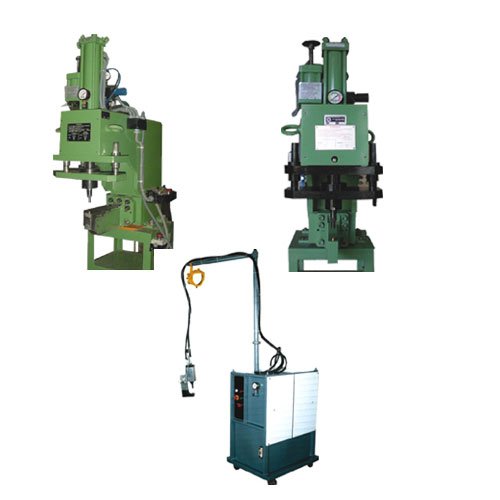
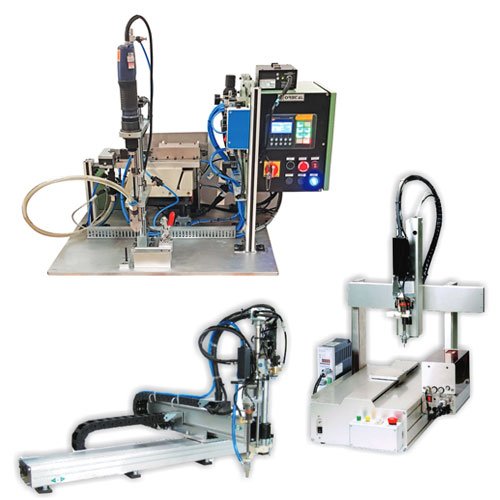
Our Products
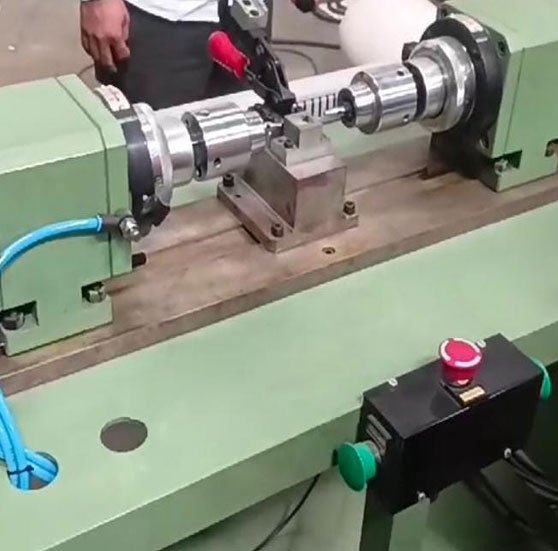
Spin Riveting Machine
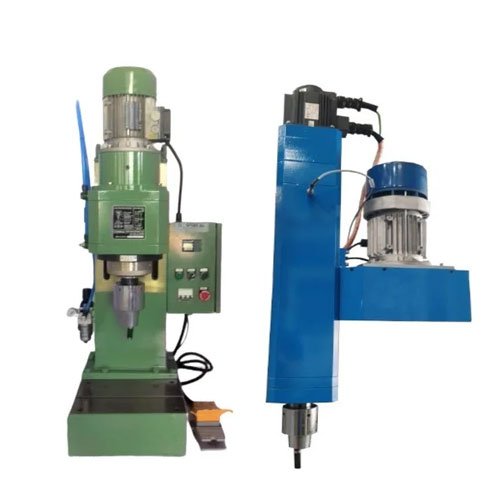
Dual Head Riveting Machine
Multi Spindle Head Riveting Machine
Multi Point Riveting Machine
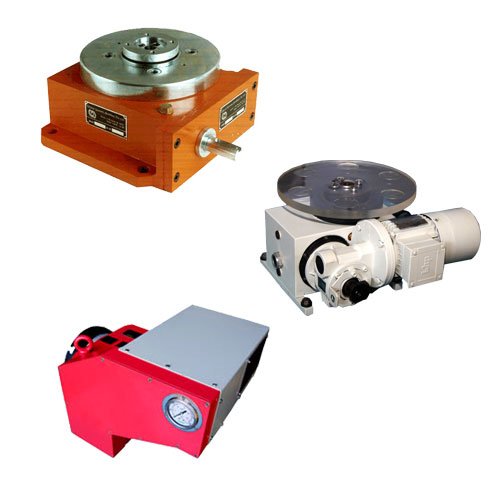
Modular Units
Special Purpose Machine


  Technical Specification  
   
Model Riveting capacity (M.S. 38 Kg/mm2 U.T.S) Throat depth Shut height (Max) Stroke adjustable Cycle time adjustable Over all dimension Motor 3415V Air pressure
Model-003 3mm

110 mm

003 - 110 0-30mm 0-9.9 Sec 003 - 490x400x800 0.25HP (0.18Kw) 3-7 Kg/cm 2
Model--005 5mm 110mm 005 -160 0-30mm 0-9.9Sec 005 - 490x400x800 0.5 HP
(0.37 Kw)
3-7 Kg/cm 2
Model-008 8mm 140mm 008 - 160 0-45mm 0-9.9Sec 008 - 600x600x1100 1 HP (0.75Kw) 3-7 Kg/cm 2
Model-012 12mm 200mm 012 - 210 0-45mm 0-9.9Sec 012 - 660x610x1360 1.5HP (1.2Kw) 3-7Kg/cm 2
Model-016-H 16mm 225mm 016H - 210 0-45mm 0-9.9 Sec 016H - 510x760x7595 6.0HP (2.25Kw) 0-80 Kg/cm 2 (Hydraulic Pressure)


MULTIPOINT MULTISPINDLE RIVETING
 
     
  FEATURES :  
 
  • Micromatic stop allows stepless and precise adjustment of stroke length
  • Precise orbital motion
  • Standard accessories include digital time control
  • Rigid construction
  • Easy to service and maintain


  APPLICATIONS :  
 
Stepless adjustment of riveting force. time, stroke and speed allows the machine to perform on a wide variety
 of application. The machine can be used for a range of jobs from freely swiveling joints to clamped, torque resisting joints
.
 
     
  ADVANTAGES :  
 
  • Long tool life
  • Low axial thrust
  • Gentle deformation
  • Simple tooling and easy setup
  • Least distortion of parent material.
  • Fast operation
  • Noiseless operation
  • Protects fragile parts
  • Precise control on riveting process.


  Orbital Machines are in use in the following areas :  
 
  • Chain assembly
  • Fans
  • Clutch /brake liners
  • Toys
  • Hand tools
  • Rollers
  • Bakelite-metal assembly
  • Bicycle parts
  • Automobile / Auto electricals
  • Switch gear
  • Surgical instruments
  • Baggage
  • Electronics/Electrical parts
  • Castors
  • Business machines
  • Locks
  • Typewriters


  Operators Guide  
  The Riveting power head can be lowered or raised by turning the nut of the jacking arrangement. Follow following instructions during lowering or raising the head:-  
 
At first keep the fixture (in components loaded condition) on base and see the gap between tool tip and rivet tip. Depending upon the gap, you have to decide whether the power head is required to be  raised  or lowered from its existing level. If you have to raise or lower the level of power head follow the following steps.
 
     
  Step-1 : Loosen the nuts and raise the powerhead more than required and clamp there lightly.
Step-2 : Rotate the dial anticlockwise as seen from top till it stops rotating.
             Now the machine will work with its full stroke available.
Step-3 :
Rotate the dial clockwise as seen from top for three complete turns. Now the machine will work with a stroke = full  
             stroke – 6mm
Step-4 : Put the machine in SET mode and take a stroke.
Step-5 : Now bring the power head downwards such that tool tip is about 0.5mm away from rivet tip.Clamp the power head at this
             level firmly.
Step-6 : Put the machine into RUN mode and start the riveting.
Step-7 : Increase the stroke gradually and set the stroke as required.
Step-8 :You can lock the dial to clamp this stroke permanently with the help of grub screw 
             provided on the dial holder at the right side of operator.
 
     
  Setting the stroke:  
  For the convinience of loading and unloading the job, the stroke should be kept as large as possible. To achieve this follow the instructions given in above point in step-1 to step-8.  
 
The stroke of the spindle can be increased or decreased by rotating the micromatic dial. One graduation mark on the dial corresponds to 0.04mm. A legend plate on the head indicates the direction of rotation of the dial to increase or decrease the stroke. As seen from top of the machine, clockwise rotation of micromatic dial reduces the stroke and anti clockwise rotation of micromatic dial increases the stroke. The stroke should be set such that the rivet head is formed to the required shape but the riveting tool does not touch the workpiece.
 
 
  1. Micromatic dial
  2. Direction indicating legend
 
  Setting spindle downward speed:  
 
A flow control valve is provided on the bottom connection of the riveting power head. The speed of the spindle is controlled by controlling the outward flow of air from the bottom connection of the head. To increase the speed of the spindle, rotate the screw inside the flow control valve with a screwdriver in counter clock-wise direction.
 
     
  Lubrication points on machine and lubrication chart  
  Lubrication is needed at two points as shown in figure. Lubricated air is also important factor.  
 
Make Oil to be filled in FRL LUB Point 1 LUB Point 2
1. Castrol Magna-10 AP-3 AP-3
2. Shell R-10 NLGI-3 NLGI-3
3. Servo SPINTEK-10/12    
Lub Frequency According to the use of m/c Once in two weeks Once in two weeks
Remarks Fill the lubricator bowl upto the mark 2-3 strokes of grease gun 2-3 strokes of grease gun
 
  For air lubrication sufficient oil quantity and proper setting of 1 drop per 15 strokes is important.  
     
  Removing tool holder from the spindle:  
 

To remove or mount tool holder on the spindle use the tool kit supplied with the machine. This  consists of a  C’ spanner and a open end spanner for model 005 and two C’ spanners for model 008, 012 .

1. Engage the  C’ spanner / open end spanner with rotary spindle and rest the C’spanner / open end spanner on the machine frame.

2. Engage the other C’spanner in the tool holder and rotate it in clock wise direction as shown.


  Trouble Shooting Guide:  
 
TROUBLE POSSIBLE CAUSE REMEDY
 1.Motor not rotating.

 -No three phase supply.

 -Check three phase,  415 V supply at  
  panel.

   -Contactor, O/L Relay.

 -Check setting on Overload Relay and
  reset the Relay if required.

 2.Spindle not
    coming down.

 -No air supply.

 -Check whether the system is connected
  to compressed air supply.  Minimum air 
  supply pressure should be 3.0 kg/cm.sq.

   -Filter unit clogged

 -Drain water collected in the filter bowl. 
  Remove filter element and clean in petrol.

   -Solenoid valve is not
  operating.

 -Check electric supply at solenoid coil.  
  Replace coil if found defective.

     -Check PCB Card.
     -Check whether there is NEUTRAL
  connection on the terminal strip.  A bulb
  must glow when connected between
  phase and neutral.  If not, connect 
  neutral from mains supply.
   

 -Check the continuity of glass fuse in
  the panel. Replace the fuse if it is
  defective.


 -Foot switch connection
  loose Or faulty.


 -Check continuity of wire going to foot  
  switch.
 -Check and replace foot switch if required.

   -Timer setting is zero.

 -Check timer setting and set it for
  required  cycle time if necessary.

 3.Spindle not going
    up.

 -Manual override of
  Solenoid Valve is ON 
  i.e. operated.

 -Check if the manual override of solenoid
  valve is ON. It should be always OFF
  i.e. at its normal position.

   -Toggle switch in SET 
  MODE.
 -Change the toggle switch to Run mode.
 4.Riveting finish Poor.  -Tool worn out.

 -Check tool length whether it is as per   
  drawing or not.


 -Downward travel speed
  of spindle is very fast.

 -Reduce the spindle speed by tightening
  the screw of flow control valve and set it
  as required by trial and error method.
   -Tool holder defective.  -Dismantle the tool holder and check for
  worn out bearings and replace if required.
 5.Incomplete 
    Riveting.
 -Inlet air pressure is low  -Increase the air pressure by regulator
  (Max.air pressure 6.0 kg/cm.sg)
 

 -Riveting time too short.

 -Increase the time setting on the thumb   
  wheel switch on the panel.

   -Insufficient Stroke  -Check that the required stroke is within
   the capacity of the machine. If 
   necessary bring down the power head to
   achieve full riveting
 

 -Insufficient force
  developed by the
  cylinder due to internal  
  leakages.

 -Check the cup seals and O-rings for
  leakage. Replace damaged cup seals &
  O-rings.


Copyright 2008@ Orbital Systems Pvt. Ltd. All Right Reserved